How to Handle Negative Electrician Reviews: The Reputation Recovery Playbook for a Safety-Critical Trade
In a trade where bad work means house fires and code violations, a single unanswered negative review does not just cost you jobs — it makes homeowners question whether you are safe to hire. This is the proven response framework that neutralizes damaging reviews, rebuilds trust publicly, and turns your worst moments into your strongest proof of accountability.
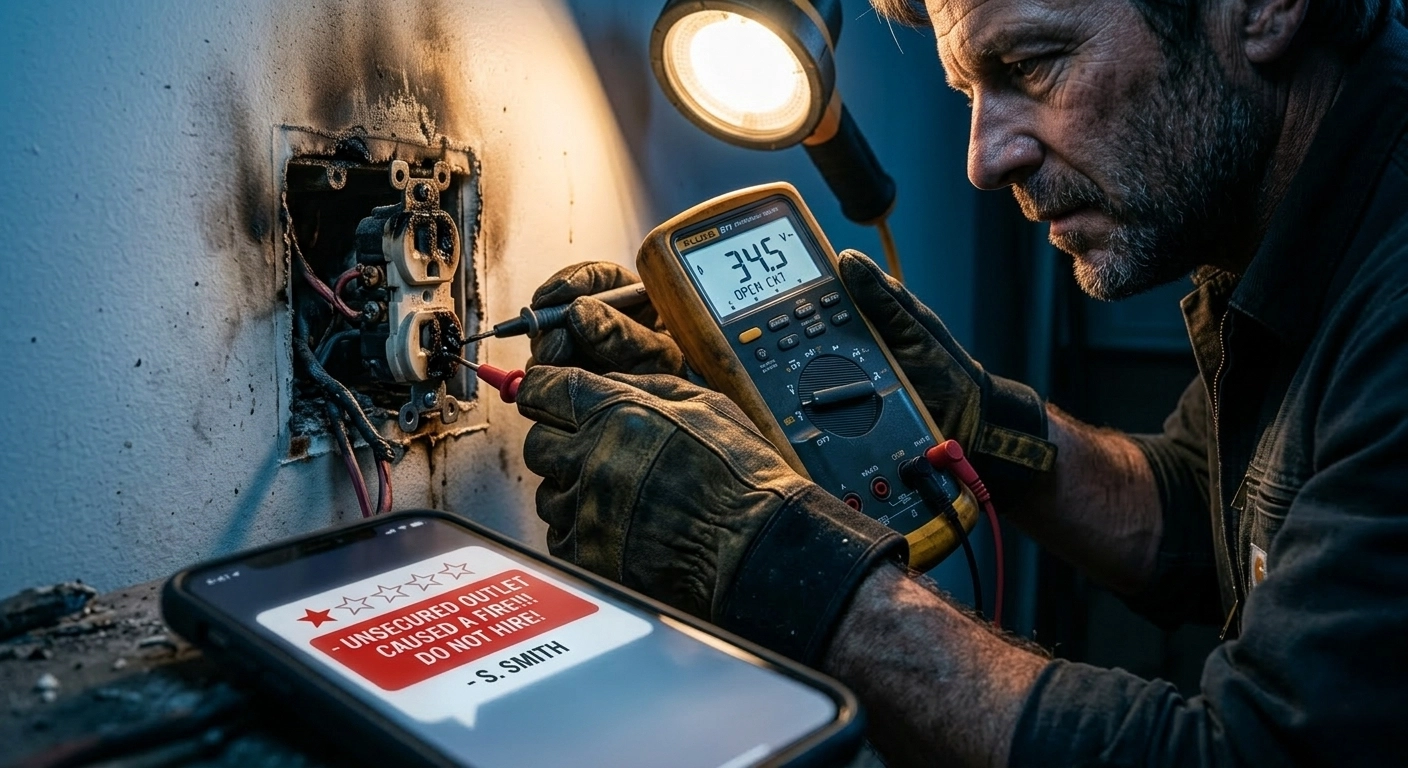
1Why a Bad Review Hurts Electricians More Than Any Other Trade
A bad review for a landscaper means an uneven hedge. A bad review for an electrician means someone is questioning whether their family is safe in their own home.
Electrical is a safety-critical trade. When a homeowner reads a review that says "They left exposed wires in the attic" or "Failed inspection twice," they are not weighing a minor inconvenience. They are picturing a house fire. They are imagining their insurance claim being denied. They are closing your tab and calling someone else.
This is the fundamental difference between your trade and every other home service: the cost of perceived incompetence is fear, not frustration.
Consider what happens with a single unanswered negative review on your profile:
- A homeowner needs a panel upgrade. They have three tabs open. They see a review on your profile that says "The inspector found two code violations on their work." No response from you. Tab closed. That is a $4,000 to $8,000 job that just walked to your competitor.
- Another homeowner is pricing whole-home rewiring. They see "They left the old knob-and-tube in place and just ran new wire around it — my insurance company flagged it." No response from you. That is a $12,000 job gone.
Silence next to a safety complaint is not neutral. It reads as confirmation.
The Hard Truth: Homeowners will tolerate a bad review about price or scheduling for a painter or a cleaner. They will never tolerate a bad review about safety for the person wiring their home. Your response to every negative review is not damage control — it is a public safety statement that every future customer will read before they call you.
2The 3-Step Response Protocol: Validate, Reframe, Resolve
When a customer accuses you of shoddy work, overcharging, or failing an inspection, your instinct is to defend yourself. Resist it. Every word you type publicly is being read by dozens of future customers for every one angry reviewer. Write for them.
Step 1: Validate the Concern (Disarm)
"We understand how unsettling it is to have concerns about your home's electrical system. Your family's safety is something we take very seriously, and we want to make sure every job meets the highest standard."
This is not an admission of fault. This is proof that you understand what is at stake — and that you do not dismiss safety concerns.
Step 2: Restate Your Standard (Reframe)
"Every job we complete is done to current NEC code, and we pull permits on all work that requires them. If something about your experience did not meet that standard, we need to know about it so we can address it directly."
You have just told every future reader that you follow code, pull permits, and hold yourself accountable — without sounding defensive.
Step 3: Move It Offline (Resolve)
"I would like our lead electrician to review your job personally. Please reach out to [Name] at [Phone/Email] so we can go over the specifics and make this right."
This does three things: it shows you take action, it moves the details out of public view, and it gives you a real chance at resolution.
Critical Rule for Electrical: If the review mentions anything related to safety — fire risk, code violations, exposed wiring, failed inspections — your response must address the safety concern directly. Do not use a generic reply. A response like "We take all feedback seriously" next to a review about a code violation looks evasive. Instead: "We take code compliance seriously on every job and want to investigate this immediately." Name the concern. Show you heard it.
3How Google Rewards Electricians Who Respond to Every Review
Google does not just display your reviews — it tracks how you interact with them. A Google Business Profile where the owner responds to every review within 24 hours sends a direct signal that your business is active and engaged. That signal influences where you show up in the Local Map Pack.
From Google's perspective, an electrical company with 60 reviews and zero owner responses looks abandoned. A company with 60 reviews and a thoughtful reply on each one looks like a business that stands behind its work.
What separates a basic response from one that builds rankings and trust:
- Name the specific work: "Glad the 200-amp panel upgrade went smoothly and passed inspection on the first visit." This proves you did real work and feeds Google a keyword it can associate with your profile.
- Reference the service type: "EV charger installs in older homes can be tricky with the panel capacity — happy we could get your Level 2 charger running without any issues." That is a keyword-rich snippet Google can index.
- Use the customer's first name: Personalization signals authenticity to both Google and the reader.
- Mention the inspection or permit when applicable: "Glad the city inspector signed off on the rewiring without any corrections needed." This is a trust signal that is unique to licensed trades and it reinforces your credibility every time a stranger reads it.
The compound effect:
Every personalized response is a small piece of unique content on your profile. Over 100 or more reviews, this creates a wall of context-rich text that strengthens your relevance for dozens of electrical search terms — panel upgrades, EV chargers, rewiring, code compliance, and every city name you mention. Your competitors who ignore their reviews are handing you this advantage for free.
4The 'Wall of Proof' Strategy: Bury Bad Reviews With Volume and Specificity
You are almost never getting a legitimate negative review deleted. Google only removes reviews that violate its policies — spam, hate speech, conflicts of interest. A review that says "They charged me $1,200 for a panel repair" is an opinion, and it is staying up.
Your weapon is volume and specificity, not deletion.
The goal is to build a relentless stream of genuine, detailed positive reviews that makes any single negative review look like an outlier, not a pattern. For electricians, this strategy has a twist: your positive reviews need to emphasize safety and code compliance because that is what neutralizes the fear a negative review creates.
The benchmarks you need to hit:
| Metric | Target | Why It Matters for Electrical |
|---|---|---|
| Total Reviews | 75+ | Below 50 and homeowners question your track record on a safety-critical trade |
| Star Rating | 4.7–4.9 | A perfect 5.0 looks fake. 4.7 is the sweet spot for conversion |
| Review Frequency | 4–8 new reviews/month | Google favors consistent, recent activity on your business profile |
| Response Rate | 100% | Every review gets a reply within 24 hours — non-negotiable |
| Safety Language | Named services + code/inspection mentions | "Great electrician" is weak. "Upgraded our panel to 200 amps, passed inspection, labeled every circuit" is gold |
How to generate this volume ethically:
- Ask at the moment of peak confidence — right after the breaker holds, the lights come back on, or the inspection passes.
- Use a short, direct text link. Every extra click cuts your response rate.
- Train your electricians to say: "If you are happy with the work, a Google review mentioning the specific job really helps other homeowners find a licensed electrician they can trust." Tie the ask to safety and licensing — it gives the customer a reason that feels meaningful, not transactional.
5The 'Updated Review' Play: Turn Your Worst Critic Into Proof of Accountability
There is one type of review that outperforms every five-star rating on your profile: the updated review.
This is the review that originally said "Failed inspection, had to call another electrician to fix their work" — and now reads: "UPDATE: The owner called me personally, sent their senior electrician back the next day, corrected everything at no charge, and the inspection passed. They stood behind their work."
That updated review does more for your credibility than fifty generic "great service" reviews. It proves the one thing every homeowner is terrified to test: what happens when something goes wrong with the wiring in my house?
For electricians, the updated review play is especially powerful because of the inspection system. If the original complaint was about a failed inspection, and you can show that you sent a senior tech back, corrected the issue, and the work passed on re-inspection — that is an independently verified recovery story. No other trade has that kind of third-party validation built into the process.
The recovery script:
After you have resolved the issue offline:
"Hi [Name], I am glad we were able to get your [panel upgrade / rewiring / circuit work] corrected and through inspection. We genuinely appreciate you giving us the chance to make it right. If you feel the resolution reflected the kind of work you would expect from a licensed electrician, would you consider updating your review? It helps other homeowners see that we stand behind our work — even when we stumble."
Rules:
- Never offer a discount or freebie in exchange for a review update. That violates Google's policies.
- Only ask after the customer has explicitly expressed satisfaction.
- If they say no, thank them and move on.
The Bottom Line: Your negative reviews are not permanent damage. They are dormant opportunities. Every complaint is a chance to publicly demonstrate that you fix problems, pass inspections, and operate at a standard that separates a professional electrical contractor from an unlicensed handyman.
6The Nuclear Review: When Someone Mentions Fire Risk or Failed Inspections
Most negative reviews sting. A review that mentions fire risk, unsafe wiring, or a failed code inspection is a business emergency.
In any other trade, a bad review about price or scheduling fades into the background once you build enough positive volume around it. But a review that says "Their work failed inspection and the inspector said it was a fire hazard" does not fade. It sits on your profile like a warning label. Every homeowner who reads it — no matter how many five-star reviews surround it — will pause.
This is because electrical safety is binary in a homeowner's mind. The wiring is either safe or it is not. There is no "mostly safe." A single review questioning your safety record triggers the same instinct as a restaurant review mentioning food poisoning. People do not take the chance.
How to handle a safety-related review:
-
Respond within hours, not days. The longer a safety accusation sits unanswered, the more damage it does. Every hour without a response is an hour where potential customers see the accusation and your silence.
-
Address the safety concern by name. Do not dance around it. If the review says "failed inspection," your response must include the words "inspection" and "code compliance." Say: "Code compliance is the foundation of everything we do. We want to look into exactly what happened on this job."
-
Offer a specific resolution. Not "call us to discuss" — that sounds like a stall. Instead: "I would like to send our lead electrician to your home to review the work personally, at no charge, and ensure everything meets code before scheduling a re-inspection."
-
Follow through and request the update. If you resolve it and the work passes re-inspection, this becomes your single most valuable review. Ask for the update using the script above.
Prevention is better than recovery. Build internal quality checks so inspection failures are rare. Require a senior electrician to sign off on permitted work before the inspector arrives. Track your first-time pass rate. The best way to handle a review about a failed inspection is to make sure it almost never happens.